


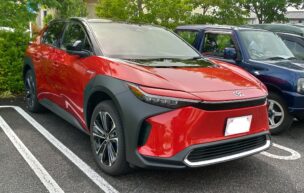
In January 2026, a major revision of the eco-car subsidy "CEV Subsidy (Clean Energy Vehicle Introduction Promotion Subsidy)" was implemented.
This revision is not just a uniform increase, but a large increase in Toyota and Tesla, while China's BYD, which competes for the top market share in the world, has been "unchanged", resulting in a large gap with other companies.
Personally, I think that while Japan's superiority in gasoline and hybrid vehicles, which are good at being recognized around the world, I think it would be better to expand EV subsidies again, but there is also the intention of the United States, and political considerations have been made.
Today, we will look at the latest subsidy situation along with specific examples of amounts for each vehicle type
Examples of subsidies for representative models from January 2026
First, let's compare the expected subsidy amounts for major car models that are attracting attention in this revision in a table.
◆List of subsidy examples of representative models of each manufacturer
| Automakers | Vehicle model name | Subsidy | Trends and Background |
| Toyota | bZ4X | 1,300,000 yen | Significantly increase to the maximum amount |
| Nissan | Aria | 1,290,000 yen | Evaluation of maintenance network and power supply function |
| Tesla | Model 3 | 1,270,000 yen | Improvement of the company's charging network is subject to additional points |
| Mazda | MX-30 | 870,000 yen | Medium-sized subsidies depending on cruising range, etc. |
| BYD | SEAL | 350,000 yen | Remain unchanged from the current |
Toyota, Nissan, etc. While major models of domestic manufacturers and Tesla will increase significantly by about 400,000 yen, BYD will keep all models, including SEAL and Sea Lion 7, unchanged It became.
Until now, the main standard for subsidies was "cruising range", but factors other than vehicle performance, such as "charging infrastructure development" and "after-sales service network", are scored and are directly related to the amount.
Why is Toyota Tesla "1.3 million" and BYD "350,000"?

It is worth mentioning in this revision that between Toyota "bZ4X" Tesla "Model 3" and BYD models, the subsidy amount A difference of nearly 1 million yen This is the point where it is born. The main factors are as follows.
1. Evaluation of the "Infrastructure and Service Network" in Japan
In this revision, the emphasis is on how much investment manufacturers are making to promote EVs in Japan (installing fast chargers and securing maintenance plants).
-
Toyota and Nissan: There are dealers and maintenance networks spread across the country, and the power supply system in the event of a disaster is in place, so the evaluation is close to perfect scores.
-
Tesla: The fact that the company has its own fast charging network "Supercharger" spread throughout Japan was highly regarded as an "infrastructure contribution".
-
BYD: Although the number of stores is rapidly increasing, compared to manufacturers with many years of experience, they are at a disadvantage in terms of the number of maintenance bases and parts supply system, resulting in a reduction in the amount of subsidies.
2. "External pressure" from the U.S. Trade Representative (USTR) and international standards
Behind this revision is a strong demand from the United States. In 2025, the U.S. Trade Representative was criticized for "Japan's subsidies are too advantageous to Japanese manufacturers (non-tariff barriers)."
In response to this, the government has adjusted the system to allow overseas companies such as Tesla to receive high subsidies depending on their contribution to infrastructure. As a major consequence, Tesla's upper limit has been raised from 900,000 yen to 1.27 million yen.
Fuel cell vehicles (FCVs) are significantly reduced
On the other hand, up to 2.55 million yen has been subsidized as the "ultimate eco-car" so far FCVs (fuel cell vehicles) will be significantly reduced to 1.5 million yen from April 2026 It will be.
FCVs such as the Toyota "Mirai" have received generous protection so far, but due to the global trend of EV shift and the point from the United States that "excessive subsidies for specific models are unfair", it has been revised.
If you are considering purchasing an FCV, you can avoid a significant reduction by registering by the end of March 2026, before the subsidy revision.
BYD's trump card? Launched around the summer of 2026 "BYD RACCO"

BYD wants to use the mini EV "BYD RACCO" scheduled to be launched in Japan around the summer of 2026 as a catalyst for market share expansion.
Head-to-head confrontation with "Sakura" in the mini EV market
"RACCO" is a specially designed model that meets Japan's unique mini vehicle standards. Currently, the Japanese mini EV market is led by Nissan "Sakura", but if sea otters are introduced, it will become a strong rival. The main points of selling sea otters are as follows.
-
Price Competitiveness: The body price is expected to be around 2.5 million yen, and it is expected to be set at the same or lower as Sakura.
-
Impact of the Grant: The upper limit of subsidies for mini EVs is 580,000 yen (determined). If BYD can accelerate the installation of domestic maintenance networks and chargers by summer and improve manufacturer ratings, it may apply a subsidy close to full to sea otters.
-
Scenario for Share Expansion: If a subsidy of 580,000 yen comes out for sea otters, The actual purchase price is less than 2 million yen It will be calculated. The scenario of making up for the difference in subsidies for ordinary cars "SEAL" with this "sea otter" and sweeping the mini car market, which is Japan's volume zone, becomes a reality.
BYD "Sea otters" are summarized in the article below, so please refer to them if you like.
BYD's new mini EV "Sea otter" price, range, and subsidies are expected
Compare purchases when considering switching

When switching to an EV, the dealer (dealer) where you buy is also actively trading in or purchasing, but it is better to compare it with the buyer in order to sell the car you are currently driving in better conditions.
Among the purchasing companies, there is a high probability that "Nextage", which has strong sales and momentum in its own company, will offer a high price.
The annual purchase volume of "Nextage" is 283,000 units (fiscal year ending November 2025), far exceeding Gulliver's annual purchase volume of 183,000 units (fiscal year ending February 2025), making it the second largest in Japan It has become. As shown in the table below, the number of purchases of "Nextage" has been growing steadily year by year, and it is expected to expand for some time to come.
◆Graph of the number of nextstage purchases

Nextage is strengthening its purchases due to strong retail sales at dealerships, and high-quality cars with advanced models and low mileage are particularly favorable.
On the other hand, "Nextstage" does not actively offer prices for cars that are difficult to sell at dealerships such as those with low age and high mileage, so in such cases, it is better to include "Upos" or "Rabbit", which are strong in auction sales is.
When searching for other companies' purchasers and requesting an appraisal, you can easily narrow down the purchase stores by using "Car Sensor Net". You can request an appraisal from the official website below.
To request an appraisal from one Nextage company, you can request it from the official website below.
Finally
The CEV subsidy revision from January 2026 was mainly aimed at ensuring fairness based on the Japan-US tariff agreement.
As a result, domestic manufacturers and Tesla have become a major subsidy elephant, but it is unclear whether EVs will spread all at once, partly due to the decline in gasoline prices and the state of infrastructure development in Japan.
However, it is also true that each manufacturer is introducing new EVs one after another, and especially for mini cars, Honda and Suzuki will introduce new models, and BYD will also enter the market, so the market share of each manufacturer is likely to fluctuate in 2026.
In addition to the national CEV subsidy, each local government also provides subsidies, so if you are considering purchasing, we recommend that you check the details of the subsidy amount at the dealer (dealer) in advance.

